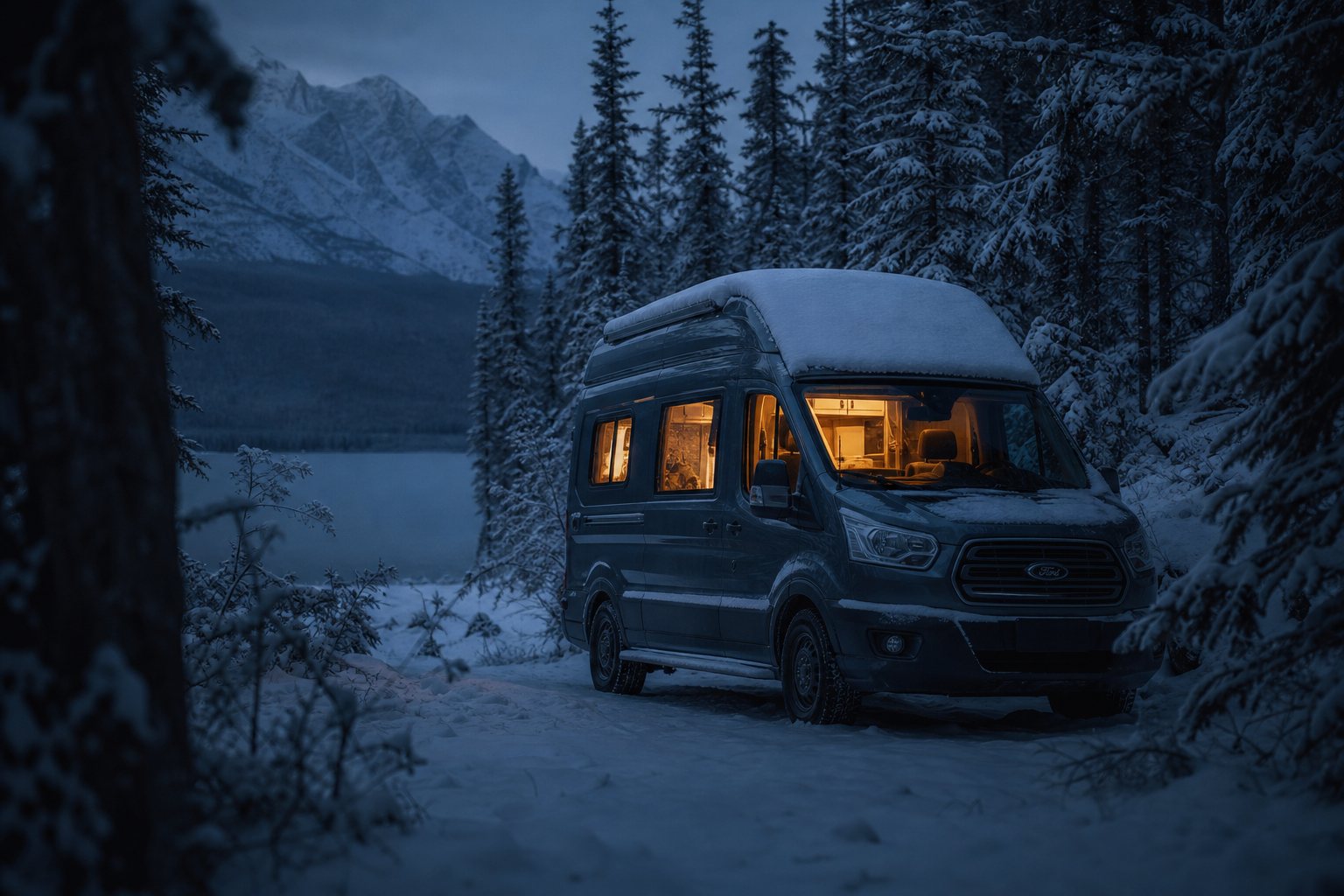
A Canadian winter does not forgive improvisation. At -30 °C, the gap between "uncomfortable" and "dangerous" is small, and the failures stack: a heater that quits, a battery that won't charge, a water line that splits overnight. This guide is about staying warm and safe — and being honest about what can actually hurt you.
The CO detector is non-negotiable
Read this part twice. Carbon monoxide is colourless, odourless, and tasteless — you cannot sense it before it incapacitates you, and it is a leading cause of unintentional poisoning deaths in Canada (Health Canada).
- Install a battery-powered CO alarm rated for low temperatures, mounted at roughly sleeping height. Test it. Carry spare batteries.
- Any combustion heater, a running engine, or a generator near your intake can produce CO. Never run a vehicle engine or a portable generator to "warm up" while you sleep.
- A second alarm is cheap insurance. One detector is a single point of failure for your life.
This is the one rule with no rukhsa (no concession). Everything else in this guide is optimization. This is survival.
Heat sources: diesel vs propane
The honest summary: a properly installed, externally-vented diesel air heater is the standard for Canadian winter van living, and the reason is dry, separated combustion.
Diesel air heaters (Webasto, Espar/Eberspächer, or budget "Chinese diesel heaters") draw combustion air from outside, burn it in a sealed chamber, and exhaust outside. Only clean, dry warm air enters your living space. They sip fuel and run on the diesel you can buy anywhere. This separation of combustion from cabin air is the core safety advantage.
Propane comes in two forms, and the distinction matters:
- Vented propane furnaces (e.g. Propex) exhaust combustion outside — similar safety logic to diesel.
- Unvented "buddy"-style catalytic/radiant heaters dump all their combustion products into your living space. Burning propane produces roughly 1.6 lb of water vapour per pound of fuel (combustion chemistry, widely documented). In a sealed van at -30, that water becomes condensation, then frost, then mould — and any incomplete combustion adds CO. Unvented heaters are a daytime, well-ventilated, awake-and-watching tool at best, never an overnight sleep heater.
Whatever you run, crack a vent. Combustion needs oxygen, and you are not airtight by accident — you want airflow on purpose.
Condensation: the slow problem that ruins the build
Even with a dry diesel heater, you are a humidifier. Two sleeping adults can release several litres of moisture overnight through breath and perspiration (Travellers Autobarn). Cooking and unvented propane make it dramatically worse.
- Run a roof fan on low exhaust and crack a downwind window — ventilation plus heat is what actually clears moisture.
- Wipe down window frames and the coldest metal each morning before frost builds.
- Insulate thermal bridges (bare metal ribs, the floor) so warm moist air has fewer cold surfaces to condense on.
Keeping water lines from freezing
Water freezes and expands, and a split line is a wet, expensive failure at the worst time.
- Keep plumbing inside the heated envelope, not in uninsulated cavities or exterior compartments.
- For overnight cold snaps, drain what you can. Many full-time winter vanlifers run jerry cans they bring inside rather than fixed tanks.
- Self-regulating heat tape (with adequate battery/shore power) protects exposed runs, but it is a power draw — budget for it.
- Varies — confirm for your build: the freeze point depends entirely on where your tanks and pump sit relative to your heat source. Test before -20, not during it.
Battery cold-derating and the lithium charging rule
This catches people every winter. LiFePO4 (lithium) batteries must not be charged when the cell temperature is below 0 °C. Doing so causes lithium plating that permanently damages the cells.
- Below 0 °C, charge current should be reduced to about 0.1C, and below roughly -10 °C charging should be avoided entirely (RELiON).
- Discharging in the cold is fine — it's charging that's destructive (Victron community).
- Buy batteries with a low-temperature charging cutoff in the BMS, or self-heating lithium, or keep the battery bank inside the heated cabin. A solar charge controller happily pushing current into a -15 °C battery will kill it.
- Expect reduced usable capacity in the cold — plan for less than the label.
Plan power before the storm: less solar in winter, shorter days, and a battery that won't take a charge until it warms up.
Where to legally overnight at -30
When weather turns dangerous, you need a lit, plowed, populated lot — not a remote pullout. Canadian options, with honest caveats:
- Walmart — Permission is "extended by individual store managers, based on availability of parking space and local laws" (Walmart corporate FAQ). Translation: it is not a guaranteed right. Many lots post no-overnight signs, and municipal bylaws override store policy. Go in, buy something, ask the manager, read the signs.
- Casinos — Several Canadian casinos are reported to tolerate overnight RV parking. Casino Rama (Orillia, ON) operates 24/7 with free parking for 2,500+ vehicles (Casino Rama), and travellers have long reported free overnight stays there with a permit from security and per-night limits — but Casino Rama publishes no official overnight-parking policy, so treat that as reported, unconfirmed. Phone the Call Centre (1-800-832-7529) or ask security on arrival before counting on it. Policies change without notice.
- 24-hour big-box and truck stops — Pilot/Flying J, some Canadian Tire and grocery lots. Always ask; always confirm there is no posted prohibition.
The hard truth: overnight parking is governed by municipal bylaw, and those bylaws differ in every town. What is tolerated in one Ontario municipality is ticketed in the next. There is no national right to sleep in a lot. Confirm locally is not a hedge — it is the actual legal situation.
Use the Muddy Tires overnight-parking layer to find lit, vetted lots near you and check the per-location notes, but treat the bylaw status as confirm-on-arrival every time.
The honest bottom line
Winter van living in Canada is done safely every year — by people who respect three things: a working CO alarm, dry vented heat, and a battery/water plan made before the cold hits. Cut a corner on any of those and the Canadian winter will find it.
Sources
- Health Canada — Carbon monoxide overview: https://www.canada.ca/en/health-canada/services/air-quality/pollutants/carbon-monoxide.html
- RELiON — LiFePO4 cold-temperature charging: https://www.relionbattery.com/knowledge/how-do-lifepo4-batteries-perform-in-cold-temperatures
- Victron Energy community — charging LiFePO4 below freezing: https://communityarchive.victronenergy.com/questions/207794/slow-charging-lifepo4-when-freezing-weather.html
- Propane combustion water-vapour output: https://www.tinywoodstove.com/how-much-water-does-burning-propane-produce/
- Travellers Autobarn — condensation/moisture from occupants: https://customercare.travellers-autobarn.com/hc/en-us/articles/360001504995-Condensation
- Walmart corporate FAQ — RV parking policy: https://corporate.walmart.com/askwalmart
- Casino Rama Resort — official site (24/7 hours, free parking, Call Centre 1-800-832-7529): https://www.casinorama.com/
Heater, battery, and condensation behaviour vary by build; bylaw and lot policy vary by municipality and change without notice. Confirm both locally before you rely on them.