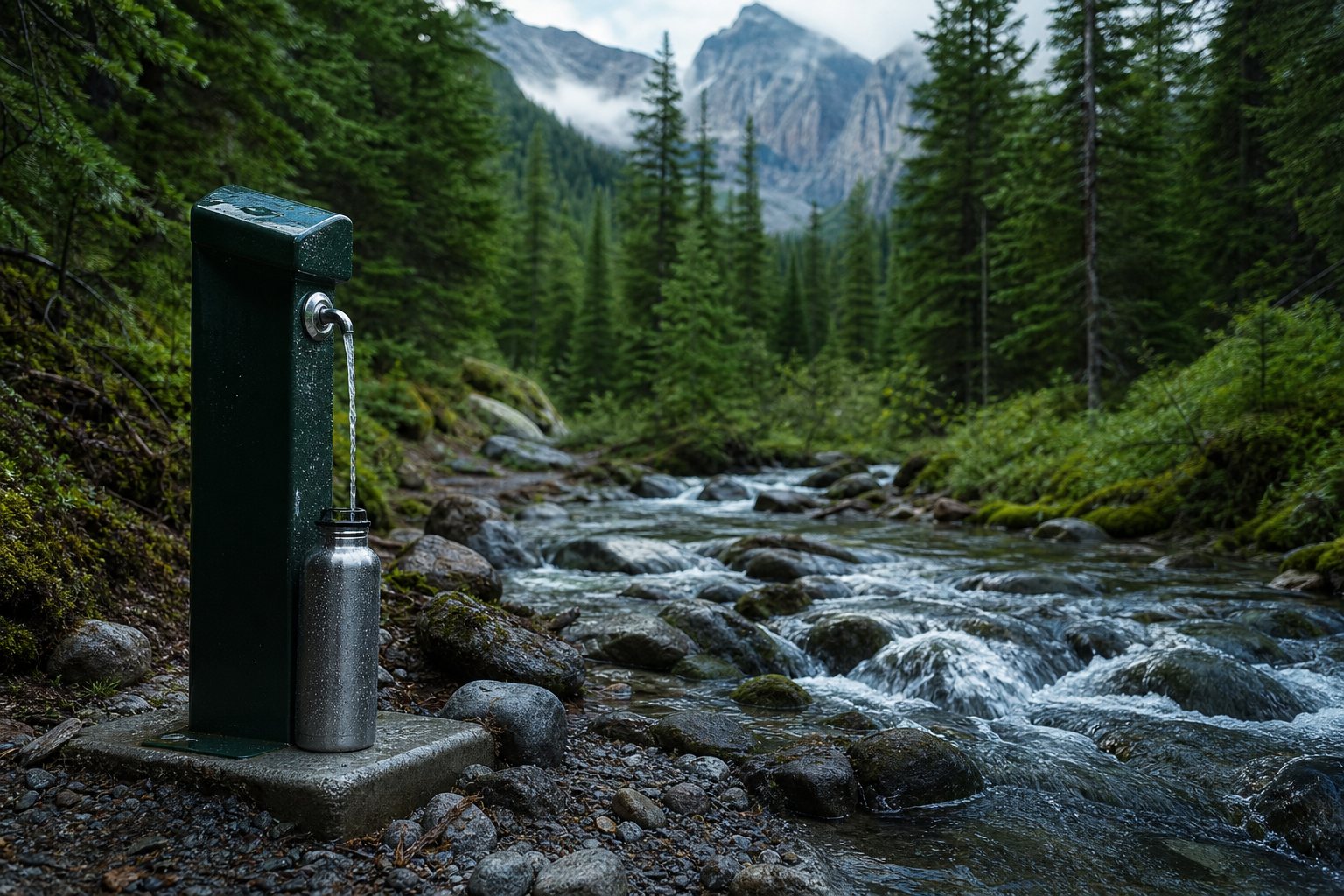
Water in, water out. Master these two and you can stay off campgrounds almost indefinitely. The good news: Canada has a dense, legal network of free and cheap fill and dump points — municipal stations, provincial parks, truck stops, even your local Canadian Tire. The bad news: most of it is invisible unless you know where to look, and the penalties for getting the out part wrong are real. This guide covers both, plus the one rule that has no exceptions.
On the Muddy Tires map, look for the water_fill pins (potable refills) and dump_station pins (sani-dumps). Toggle both layers when you're planning a corridor — they rarely sit in the same spot.
The cardinal rule (this one has no exceptions)
Never dump grey or black water anywhere but a sani-station. Not on the ground, not down a storm drain, not into a ditch, lake, or the bush. "Grey" (sink/shower) is not exempt — it carries food, grease, and soap, and most provincial and municipal rules treat ground/water discharge of any tank as prohibited.
Ontario Parks states it plainly: "Discharge or disposal of sewage or grey water onto the ground or into the water is strictly prohibited" (ontarioparks.ca/reservations/rules). Illegal dumping is enforced under provincial environmental law — in Ontario, illegal waste dumping carries fines up to $10,000 for serious offences at the regional level (Niagara Region), and provincial environmental penalties run far higher for substantial violations (ontario.ca). Exact fines vary by province and municipality — confirm locally, but the principle does not: hold it until a real station.
Filling fresh (potable) water
You need potable water for your drinking tank. Many spigots you'll find are marked non-potable (rinse only) — read the sign.
- Canadian Tire jug-refill machines — A quietly excellent option. Many stores run self-serve water-vending machines (often a Culligan/Primo unit out front). Travellers report roughly CAD $1.99 for 16 L and ~$2–2.50 for an 18.5 L jug (Reddit r/Guelph; community reports). Cheap, clean, bring your own jugs. Price and availability vary by store — confirm at the location.
- Walmart / grocery (Primo, Culligan, Reverse-Osmosis) machines — Same idea, similar price. Fill any container you bring and pay at the till.
- Provincial-park trailer fill stations — Ontario Parks restricts drinking-water filling to the dedicated fill station: "The trailer fill station is the only area of the park where visitors are permitted to fill drinking water holding tanks" (ontarioparks.ca). Don't fill from washroom or campsite taps.
- Municipal dump-and-fill stations — Many town stations include a potable spigot alongside the dump. Confirm it's marked potable, not the rinse hose.
- Gas stations and hardware stores — Often have an outdoor tap. Always ask first — it's their water and their bill. A polite "mind if I top up a jug?" works far better than helping yourself.
A note on the dump-station spigot: the water beside a sani-dump is frequently non-potable rinse water. Niagara Region warns that station water "shouldn't be used to fill drinking water tanks" (niagararegion.ca). Keep a dedicated rinse hose separate from your potable hose, and never cross them.
Dumping grey & black: free vs paid
Free municipal sani-dumps are the boondocker's best friend and more common than people assume.
- Many town and city stations are free. Niagara Region operates three (Fort Erie, Grimsby, Niagara Falls) at no charge (niagararegion.ca). Thunder Bay runs a seasonal pumping station with no charge (thunderbay.ca).
- Others are low-cost or card-only — e.g. Drayton Valley, AB charges $10, card only (Town of Drayton Valley); West Nipissing, ON moved to pay-per-use (westnipissing.ca). Most are seasonal (spring–fall) — frozen in winter.
Paid options:
- Pilot / Flying J truck stops — Reliable, widely distributed, often with a potable spigot in the RV lane. Good Sam members get 50% off the regular dump-station charge at participating Pilot and Flying J locations (Good Sam). Pilot Flying J does not publish a single national dump fee, and the base charge varies by location — the commonly reported figure is around CAD $10 (reported, unconfirmed; confirm at the location). You typically pay the cashier and get a code to unlock the cover.
- Provincial parks (non-guests) — You can usually dump without camping, but you pay. Ontario Parks charges day-users a fee to use the trailer dumping station (ontarioparks.ca/fees/trailers); some parks (e.g. Algonquin) run card-only sanitation stations reported around $15/dump (community report). Fees vary by park — confirm.
- Private campgrounds — Many accept non-guests for a small fee, often $10–20, frequently bundled with a potable refill (frontenacpark.ca).
Walmart: Canadian Walmarts do not offer dump stations, and overnight parking itself is per-store at the manager's discretion and subject to local bylaws (Walmart corporate). Don't expect to dump here — find a sani-station instead.
A workable rhythm
- Run a
water_fill+dump_stationsearch on the Muddy Tires map for your route, before you're desperate. - Top up potable at a Canadian Tire or park fill station; dump at a free municipal station where the route allows, a truck stop where it doesn't.
- Carry a separate potable hose and rinse hose, disposable gloves, and a backup of cash — many municipal and park stations are card-only or honour-box.
- Confirm hours and season — most free stations close for winter.
Get the timing right and water management becomes a five-minute errand, not a trip-planner. Get the out part wrong and it's a fine, a contaminated waterway, and one more reason towns shut these stations down. Hold it to the station. Always.
Sources: Ontario Parks rules & fees; Niagara Region; City of Thunder Bay; Town of Drayton Valley; West Nipissing; Good Sam (Pilot/Flying J member benefit); community reports via Reddit/Facebook. Money figures and bylaws vary by location and season — confirm locally before relying on them.