Most nights on the road are uneventful, and that's exactly the problem — it's easy to get sloppy. Safety out here isn't fear, it's a set of cheap habits that cost you two minutes at the time and save you the one night you really needed them. This guide covers the three things most likely to actually go wrong: a bad sleeping spot, a wildlife mistake, and a breakdown where there's no bar of signal to call for help.
None of it requires gear you don't already have. Most of it is just paying attention before you commit.
The spot gut-check: vet before you commit
By the time you're tired enough to want to stop, your judgment is already worse. So make spot selection a checklist you run before you settle in, not a feeling you have after. Roll up, scan, decide — and if anything's off, just keep driving. There's always another spot, and "I drove twenty more minutes" beats every story that starts with "I had a bad feeling but stayed anyway."
What to actually read when you pull in:
- Exits. Can you leave fast, in the dark, without a three-point turn? Back in or pull through so the nose points out. A spot you can't leave from in ten seconds is a spot you're committed to no matter what shows up.
- Lighting. A little ambient light (a lit lot, a streetlight at the edge) deters far more than it attracts. Total darkness feels stealthy but means you can't see what's approaching and neither can anyone who might otherwise notice trouble. Pitch black is for deep wilderness, not the edge of town.
- Cell coverage. Check your bars before you commit, not after something goes wrong. If you have no signal and no satellite messenger, you have no way to call for help — factor that into how remote and how alone you're willing to be.
- Signage. Walk the perimeter with your eyes before you settle. "No overnight parking," "private property," "no trespassing," a gate that closes at dusk — a sign overrides any general rule, and the spot that gets you a 2 a.m. knock is usually the one with a sign you didn't read.
- The vibe. Trust it. Broken glass, scattered garbage, a spot that's clearly someone's regular hang, a dead-end with one way in — if your gut says no, the answer is no. Your subconscious is reading details you haven't consciously clocked yet. Leave.
The whole point of a mobile home is that a bad spot is a temporary problem. Use that.
The 2 a.m. knock
Sooner or later someone taps on your van at night — security, a bylaw officer, police, or just a curious or drunk stranger. Have a plan so you're not making decisions half-asleep.
- Don't open the door. You're not obligated to, and you don't know who it is. Talk through the window or the wall. A simple "Yes? I'm fine, thanks" through the metal handles 90% of it.
- If it's an official (security, police, bylaw) asking you to move, the move is easy: acknowledge, say you're leaving, and go. You will never win an overnight-parking argument at 2 a.m., and you don't want to. This is the case for your keys living in a known spot and your rig staying in five-minute-egress shape.
- If it's anything else — a knock with no uniform, no introduction, someone who won't say what they want — you don't engage and you don't open. Start the engine. The act of starting up ends almost every situation; nobody with bad intent wants you mobile, lit, and clearly awake. Drive to a busier, better-lit spot.
- Keep the keys in the ignition or one known spot, every night. The single most useful safety feature you own is the ability to drive away. That only works if you can do it instantly, in the dark, without thinking.
This is why the low-profile habits matter — a rig that reads as "a parked vehicle" instead of "a campsite" gets knocked on far less in the first place.
Wildlife: it's a food problem, not a bear problem
If you're camping anywhere wild in Canada, you're in bear country — black bears across nearly all of it, grizzlies through the western mountains and north. The thing to understand is that bear safety is almost entirely about food and attractants. A bear that never learns your van means an easy meal is a bear that moves along. The mistakes that get people (and bears) hurt are almost all storage mistakes.
Store it like the bear is already watching
Parks Canada's rule is blunt: a tent is not bear-proof, and neither is a loosely-closed van. Move food, pet food, dishes, garbage, and anything else with an odour into a sealed bear-resistant container or a hard-sided vehicle at night — store it away from where you sleep, never in your tent. (Source: Parks Canada, "Reduce conflict — store food and dispose of garbage.")
- In a van or hard-sided vehicle, your sealed interior is your storage locker — keep food and scented items inside, closed up, not in an exterior bin or within reach of an open window. The smells are what draw a bear, so containment is the whole game.
- If you're tenting or in a soft pop-top, don't keep any of it where you sleep. Use a bear-resistant locker where one's provided, or hang it: Parks Canada specifies suspending food between two trees, at least 4 metres off the ground and 1 metre out from the tree trunks. (Source: Parks Canada, "Camping in bear country.")
- Cook and eat away from where you sleep — Parks Canada suggests cooking well downwind of your sleeping area and never in or near the tent, where lingering food odours invite bears. Never leave food or a greasy grill unattended, and pack out every scrap of garbage — a messy site trains the next bear and gets the spot closed to everyone. (Source: Parks Canada, "Camping in bear country.")
If you actually meet one
The provincial and federal guidance is consistent, and the headline is: do not run. Running can trigger a chase, and you can't outrun a bear. (Sources: Parks Canada, "Bears and people"; Ontario Bear Wise; Alberta Parks.)
- Stop. Stay calm. Your calm is information to the bear — it tells it you're a human, not prey, and not a threat. Screaming or sudden movement can escalate things. (Source: Parks Canada, "Bears and people"; Ontario, "Prevent bear encounters – Bear Wise.")
- Talk to it, calmly and firmly, so it clearly reads you as human. Make yourself look big — stand tall, raise your arms, pick up kids and pets, group up with anyone you're with. (Source: Parks Canada, "Bears and people.")
- Back away slowly, keeping the bear in sight, and give it a clear escape route. Never get between a bear and its cubs or its food. (Source: Ontario Bear Wise; Parks Canada.)
- Carry bear spray, especially in grizzly country, and know how to use it before you need it — fumbling with the safety clip during a charge is too late. Have it on your body, not in the van. (Source: Parks Canada, "Bears and people"; Alberta Parks.)
- If a bear actually attacks, the response depends on why it's attacking — defensive or predatory, not simply the species. In a defensive attack (a surprised, stressed, or cub-protecting bear — far more common, and more often a grizzly), use your spray, and if the bear makes contact, play dead: lie flat on your stomach, hands clasped behind your neck, legs spread so it can't flip you, and stay down until it leaves. In a predatory attack — a bear that stalks you calmly, or any bear coming into your tent at night (more often a black bear) — do not play dead. Fight back with everything you have, aiming for the face. (Source: Parks Canada, "If you encounter a bear" / Forillon black-bear encounter guidance.)
The defensive-versus-predatory call is the one that matters, and it's worth reading the official page for the specific park or province you're in before you go — the consensus above holds, but local pages add the species and terrain detail that matters where you actually are.
Reporting
In Ontario, a non-emergency bear (one rooting through garbage, up a tree, generally just being a bear) goes to the Bear Wise line at 1-866-514-2327, staffed 24 hours a day, seven days a week, from April 1 to November 30. A bear that's an immediate threat — stalking and lingering, trying to enter a building, attacking pets and not leaving — is a 911 call. (Source: Ontario, "Prevent bear encounters – Bear Wise.") Other provinces run their own conservation-officer lines; look up the local number for where you're parked before you need it.
The no-cell breakdown
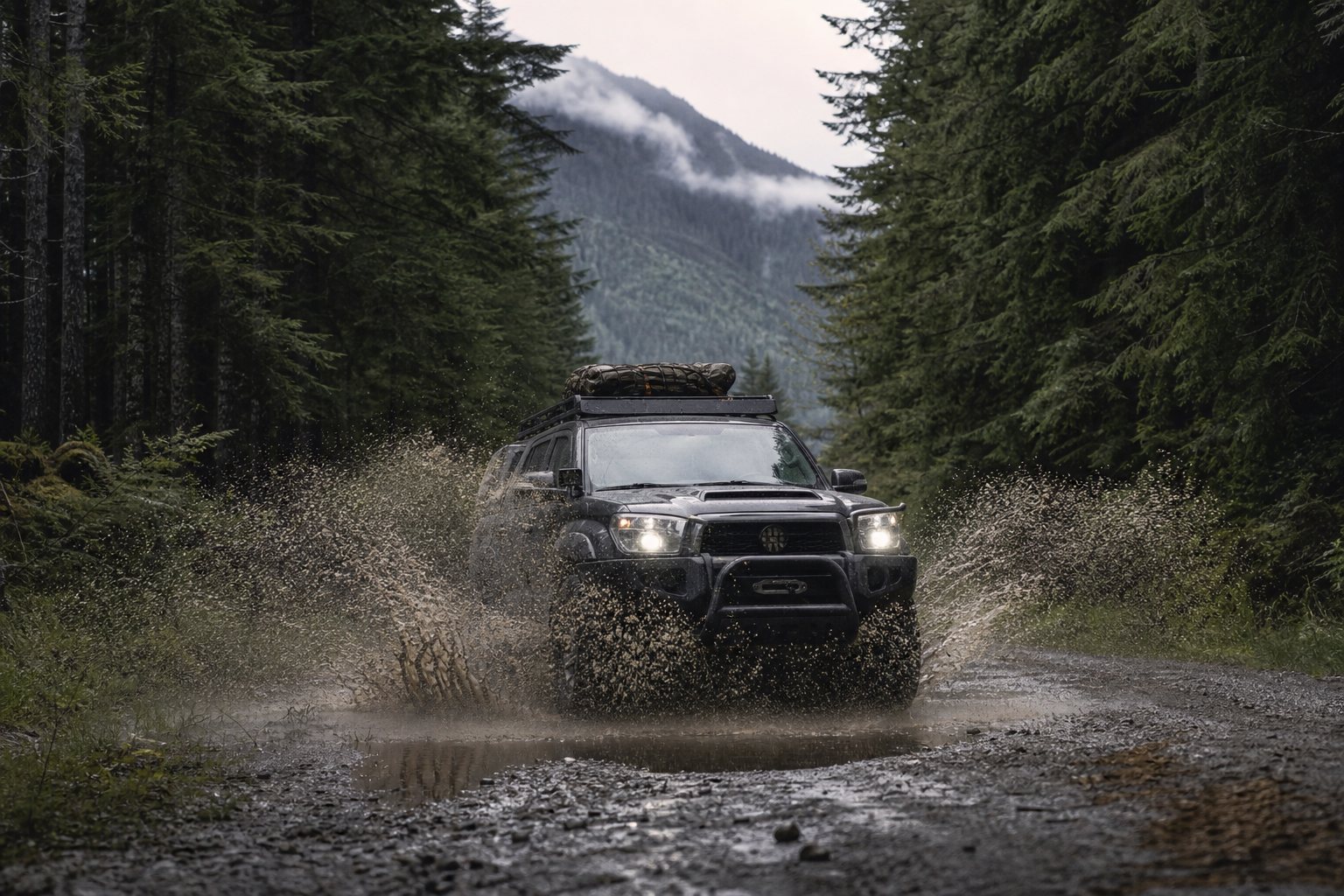
A breakdown on a busy highway is an inconvenience. A breakdown on a forest service road two hours from pavement, with no cell signal, can become genuinely serious — especially solo, in cold, or with no one expecting you. The fix is almost entirely preparation done before you lose signal.
Before you go off-grid
- Leave a trip plan with someone you trust. Where you're going, your route, and — most importantly — when you'll return and what time crosses into "something's wrong." Search and Rescue can't start looking for someone nobody's reported missing; your overdue return is what triggers the whole chain. AdventureSmart's trip-plan model is built exactly around that overdue-time trigger: give your contact your destination, route, equipment, and expected return time, plus the instruction to call local authorities if you don't return as planned. (Source: AdventureSmart, "Trip Plan.")
- Carry a way to call for help that doesn't need a cell tower. In remote Canada this is the single highest-value safety purchase you can make. Two tiers:
- Satellite messengers — Garmin inReach, ZOLEO, SPOT. These run on satellite networks (inReach uses Iridium, a low-orbit constellation with true global coverage), do two-way texting, and have a dedicated SOS button that reaches a 24/7-staffed emergency coordination centre — for inReach, the Garmin Response / IERCC team — which gathers details by two-way message, pinpoints you, and coordinates the right responders. This is the proven, purpose-built option, and it works where phones simply can't. (Source: Garmin, "Interactive SOS and Garmin Response.")
- Phone satellite SOS — newer phones now do Emergency SOS via satellite, and it works in Canada. iPhone 14 and later can text or call 911 via satellite with a clear view of the sky; Google Pixel 9 (except the 9a) and some newer Android phones added Satellite SOS in Canada in 2025. It's a real backstop, but treat it as a backup to a dedicated messenger for deep, regular off-grid travel, not a replacement — coverage, included free-service period, and capability vary by device. (Sources: Apple, "Use Emergency SOS via satellite on your iPhone"; Google Pixel Help, "Get emergency help through satellite with your Pixel phone.")
- Keep the buffer that matches the spoke. The deeper and more remote the route, the more you carry — water, food, warm layers, a basic recovery kit, and enough fuel to not be the reason you're stranded. This is the same hub-and-spoke logic as resupply: the further from the grid, the bigger the cushion.
When it happens
- Stay with the vehicle. It's shelter, it's warmth, it's vastly easier to spot from the air or road than a person on foot, and it's where your supplies are. Walking out is how a fixable breakdown turns into a search-and-rescue. The exception is the rare case where you know help is genuinely close and reachable on foot.
- Call for help first, in this order: 911 if you have any signal at all (even a phone with no active service can often still reach 911); then your satellite messenger's SOS or two-way text; then phone satellite SOS. Always try 911 first — SAR cannot be activated without a report. (Source: AdventureSmart.)
- Make yourself findable. Hazards on, hood up, something bright on the antenna or mirror. If you're on a track at all, stay near it.
- Manage temperature, not panic. In cold, layer up and run the engine sparingly for heat — but only with a window cracked and the exhaust pipe clear of snow, because carbon monoxide kills silently. Conserve fuel and phone battery; you may need both to last.
The breakdown you're prepared for is a long, boring afternoon. The one you're not prepared for is the one that makes the news. The difference is a fifty-dollar-a-year messenger and a text to a friend before you lost signal.
Wildlife and trip-planning guidance here is sourced to Parks Canada, provincial bear-safety programs, and AdventureSmart, and is current as of June 2026. Guidance, device coverage, and reporting numbers change, and species behaviour and rules vary by region — confirm the official page for the specific park or province you're heading into before you go.
Sources
- Parks Canada — Bears and people
- Parks Canada — Camping in bear country (black bear)
- Parks Canada — Reacting to a bear encounter (Forillon)
- Government of Ontario — Prevent bear encounters: Bear Wise
- Ontario Parks — Black bear safety
- AdventureSmart — Trip Plan
- Garmin — Interactive SOS and Garmin Response
- Garmin — Iridium satellite network
- Apple Support — Use Emergency SOS via satellite on your iPhone
- Google Pixel Help — Get emergency help through satellite with your Pixel phone