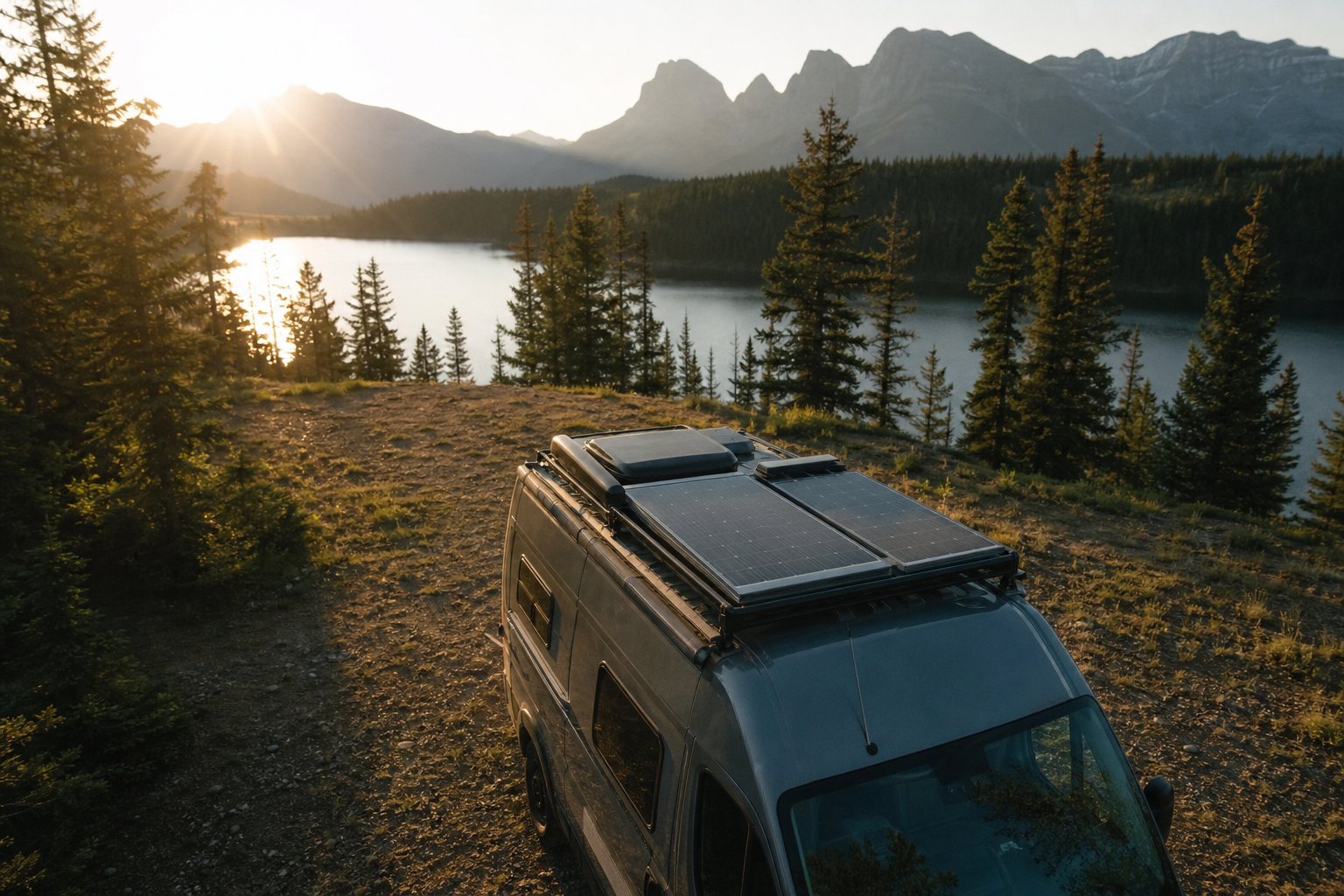
Staying online while you travel Canada is a layered problem, not a single product. Cellular gets you most of the way in towns and along major highways; a booster squeezes signal out of the fringe; Starlink fills the true off-grid gaps; and free Wi-Fi covers the rest — as long as you treat it as the untrusted network it is. Here's how to build a stack that actually works between Tofino and St. John's.
Layer 1: Your cellular plan (the workhorse)
For most nomads, a phone-based hotspot is your primary connection. Canada's "Big 3" — Rogers, Bell, and Telus — own the networks with the widest rural reach, which matters far more than urban speed when you're parked on a Crown land road.
As of May 2026, headline unlimited plans sit around:
- Rogers — $80/mo unlimited (Canada-US-Mexico-Caribbean); $95 unlimited global
- Telus — $95/mo unlimited Canada
- Bell — $80/mo unlimited (Canada-US-Mexico)
Prices change almost monthly — these are mid-2026 figures and you should confirm at checkout. (iPhone in Canada, May 2026)
"Unlimited" has an asterisk. All three throttle to roughly 512 Kbps once you pass your high-speed threshold — enough for email and maps, painful for video. (Telus)
Regional carriers can be cheaper or better-covered in their home turf: SaskTel dominates Saskatchewan (rural mobile plans from ~$85/mo for 120GB), Videotron in Quebec, and Eastlink in Nova Scotia and PEI. Freedom Mobile undercuts the Big 3 (e.g. ~$45/100GB) and bundles roaming, but its native network is urban — outside cities you fall back to a partner network. Match the carrier to where you actually spend time. (Confirm current plans directly; pricing varies.)
> Muddy Tires tip: Toggle the Cell Coverage map layer before committing to a remote site. A campsite with zero bars is a campsite where you can't post the sunset.
Layer 2: A signal booster (for the fringe)
When you have one faint bar, a booster can turn it into a usable connection. A booster pulls weak tower signal from an external antenna, amplifies it, and rebroadcasts inside your rig — common picks are weBoost kits like the Drive Reach RV.
The legal part matters in Canada. A booster must be certified under ISED's RSS-131 (Zone Enhancers) standard. Uncertified amplifiers can interfere with carrier networks and are not legal to operate here — look for an IC certification number on the box before buying. (ISED RSS-131)
A booster only amplifies signal that already exists. Zero bars in, zero bars out. That's where the next layer comes in.
Layer 3: Starlink Roam (true off-grid)
For genuine wilderness — no tower for 100 km — satellite is the only answer, and Starlink Roam is the dominant option. As of mid-2026 in Canada (CAD, confirm at checkout):
- Roam 50GB — ~$55/mo
- Roam Unlimited — ~$165–200/mo
- Starlink Mini hardware — dropped to roughly $249, with activation promos bringing the effective cost lower
(Starlink Canada service plans; pricing/promos reviewed internetadvice.ca, May 2026)
The Mini packs into a backpack and supports in-motion use on Roam plans in covered areas. You can pause the service in the app for months you're not travelling — a big deal for seasonal nomads. The catch is power draw (budget for it in your electrical system) and a clear view of the northern sky.
Layer 4: Free Wi-Fi (and why it needs a VPN)
Free Wi-Fi stretches your data budget. Reliable Canadian sources:
- Public libraries — every Canadian city and most towns; the best free workspace going. Toronto, Vancouver, and Halifax systems all offer open Wi-Fi.
- Tim Hortons, McDonald's, Starbucks, A&W — near-ubiquitous along highways.
- Gyms — if you hold a membership (e.g. Fit4Less, GoodLife), the Wi-Fi comes with the shower.
- Visitor centres, rec centres, and many provincial park day-use buildings.
The security angle — non-negotiable
Public Wi-Fi is unsecured. The Government of Canada's Get Cyber Safe program is blunt about it: on an open network, a threat actor can intercept your traffic or spin up a fake hotspot named to look legitimate. (Get Cyber Safe; travel.gc.ca)
The single most effective fix they recommend is a VPN — it encrypts everything you send through that café or library connection, so anyone snooping sees only scrambled data. Even Canada's Privacy Commissioner and the Toronto Public Library explicitly recommend a VPN on public hotspots. (Privacy Commissioner; TPL)
This is where IPVanish earns its place in your kit. A paid VPN (avoid free ones — they monetize your data) running on every device the moment you join an untrusted network is the difference between "free Wi-Fi saved me $20 of data" and "someone harvested my banking login at a rest stop." Set it to connect automatically. Treat every network you don't own as hostile.
Building your stack
- Primary: Big 3 or strong regional plan with a generous high-speed allotment.
- Fringe booster: an ISED-certified weBoost-class kit for the one-bar sites.
- Off-grid: Starlink Roam (pause it when you're home).
- Top-up: library and café Wi-Fi — always behind a VPN.
No single layer covers Canada. The stack does.
Money figures, plans, and promotions change frequently — every price here is a mid-2026 snapshot and should be confirmed with the provider before you buy. Coverage and bylaw specifics vary by location; confirm locally.
Sources: iPhone in Canada (carrier plans, May 2026) · Telus Mobility · SaskTel Rural Internet · Starlink Canada · internetadvice.ca Starlink pricing · ISED RSS-131 Zone Enhancers · Get Cyber Safe — Public Wi-Fi · travel.gc.ca cyber-safe recommendations · Office of the Privacy Commissioner of Canada · Toronto Public Library Wi-Fi safety