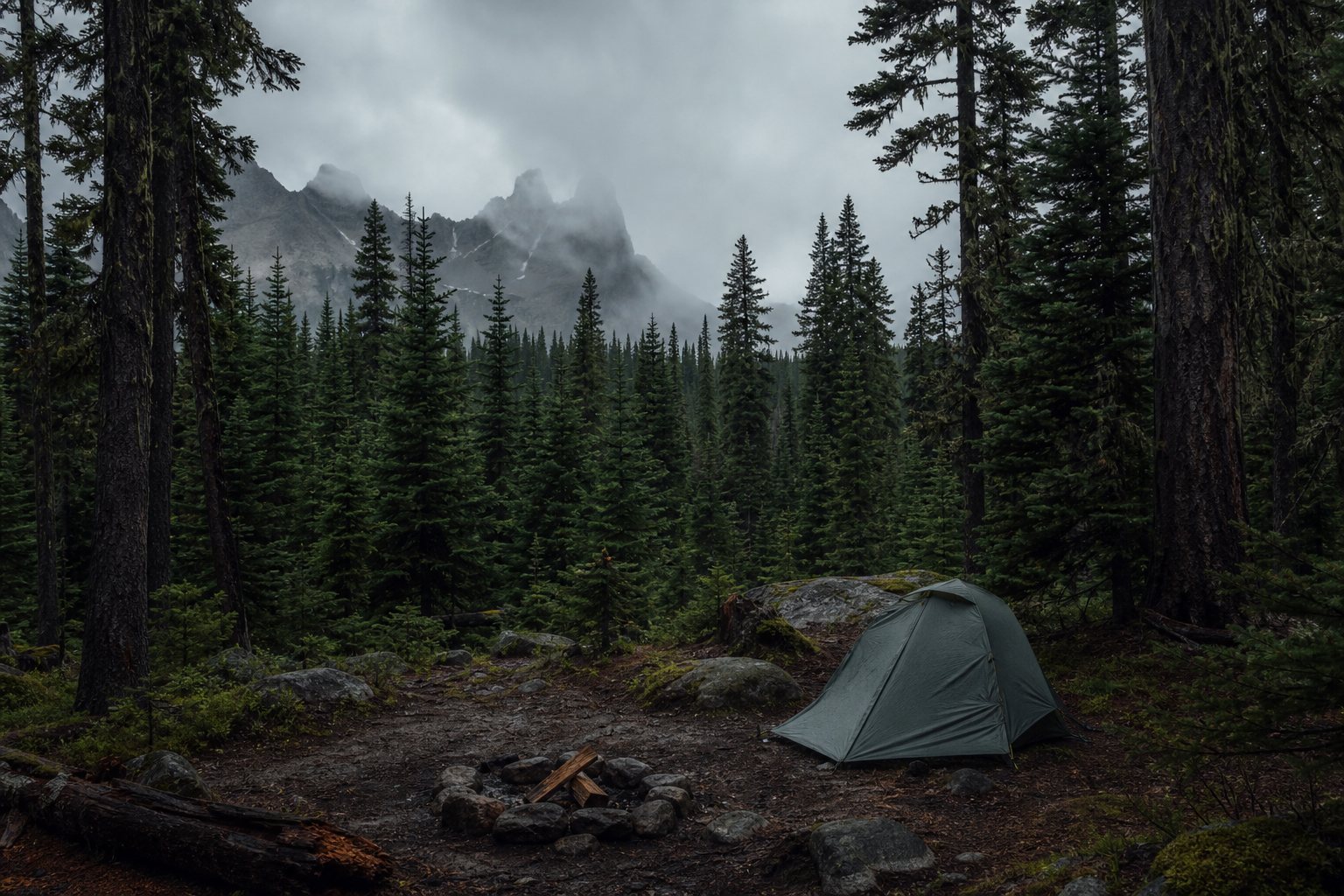
Crown land is the quiet backbone of Canadian vanlife. Roughly 89% of Canada is public land, and in most provinces and territories a Canadian resident can park a camping unit on it and sleep for free. But "free" is not "anywhere, anytime." Each jurisdiction writes its own rules, the day limits differ, some zones now charge a pass, and a surprising amount of land that looks like Crown land is actually leased, municipal, First Nations reserve, or off-limits.
This guide covers the rules that actually apply, jurisdiction by jurisdiction. On the Muddy Tires map, likely-free Crown candidates show up as VERIFY pins — they flag a plausible spot, but the legwork below is still yours.
A note before you read: the four big western and central provinces (ON, BC, AB, QC) publish clean, consumer-facing camping rules. East of Ontario and north of 60, the official guidance gets thinner — several governments tolerate short-term camping without ever publishing a tidy "you may camp X days" page. Where that's the case, this guide says so plainly instead of inventing a number.
Ontario — 21 days, then move 100 m
Camping is free on most Ontario Crown land for Canadian residents. The core rule: you may stay in one camping unit up to 21 days on any one site in a calendar year, after which you must move at least 100 metres from your previous location.
- Non-residents of Canada need a camping permit to camp on Crown land north of the French and Mattawa Rivers. The cost is $10.57 (HST included) per person, per night, bought online via the Natural Resources Information Portal or in person at ServiceOntario.
- Non-residents are barred from designated green zones entirely.
- Camping is not permitted on roads, trails, parking lots, boat launches, or land where someone else holds a permit, lease, or mining claim.
Before you commit, check the spot in the Crown Land Use Policy Atlas — some Crown land prohibits recreation outright. (Source: ontario.ca, "Recreational activities on Crown land"; O. Reg. 326/94.)
British Columbia — 14 consecutive days
BC's general rule is simple and generous: any person may camp on Crown land for up to 14 consecutive calendar days, then move on. No permit, no fee for general (unrecreated) Crown land.
- At a managed Recreation Site or Trail (RSTBC), the limit is also 14 consecutive days — and many of these sites are genuinely free. (Forest Recreation Regulation, s. 13.)
- Do not build long-term structures; pack out what you pack in.
- Watch the boundaries: a lot of "Crown land" near towns is actually municipal or leased, and BC Parks and Rec Sites have their own posted rules. If it's a BC Park, the general 14-day Crown rule does not apply — follow park signage.
(Sources: gov.bc.ca "Land Use Policy – Permission"; gov.bc.ca "Know the rules for recreation sites and trails.")
Alberta — random camping, but the Eastern Slopes now charge
Alberta calls free camping outside campgrounds random camping, and across much of the province it remains free with a 14-day maximum stay in the same spot.
The catch is the mountains. Anyone 18 or older needs a Public Lands Camping Pass to random camp along the Eastern Slopes of the Rocky Mountains (Grande Prairie to Waterton), plus the Porcupine Hills PLUZ and Willmore Wilderness Park.
- $20 per person for a 3-day pass, $30 per person for an annual pass.
- Add a $3.25 processing fee + GST per transaction, and a one-time $8 Wildlife Identification Number (WIN) to use the AlbertaRELM system.
- Sold per person, not per vehicle; same rate for residents and non-residents.
- Children/youth under 18 are exempt, as are Status First Nations peoples.
Outside the pass area, no pass is needed — but you still must know where random camping is actually allowed. (Source: alberta.ca, "Public Lands Camping Pass.")
Quebec — camping sauvage on free public land
Quebec's public land (territoire public) covers about 92% of the province and splits into structured territory (zecs, wildlife reserves, outfitters, national parks — each with its own rules) and free territory (territoire public libre).
On free public land you may camp without authorization, with two conditions: your stay must be temporary, and your equipment must be mobile and not permanently fixed to the ground.
- Some MRCs (regional county municipalities) have passed their own camping rules — these vary, so confirm locally with the MRC before relying on a spot.
- Structured land (Sépaq reserves, zecs) is not free wild camping — those are managed and fee-based.
(Source: quebec.ca, "Profiter du territoire public en toute légalité.")
Manitoba — 21 days, then move on
Manitoba is roughly 90% publicly owned, and the province's standing position is that residents of Canada may camp free on Crown land for up to 21 days at any one site, unless a site is posted otherwise, after which you move to a new location. No facilities are provided, and "leave no trace" is expected.
- Non-residents of Canada are expected to hold a camping permit; costs and conditions are set provincially.
- Building anything — a structure, a fixed camp — requires a Crown land permit; casual overnight camping does not.
- A lot of land near settled areas is agricultural Crown land under grazing or haying lease and is not open for casual camping — confirm tenure first.
Manitoba does not publish a single clean consumer page spelling the 21-day rule out the way Ontario does; the figure is the province's long-standing administrative position rather than a bright-line statute you can cite chapter-and-verse. Treat 21 days as the working ceiling and confirm with the regional Natural Resources office before a long stay. (Sources: Province of Manitoba, Natural Resources and Northern Development — Crown land program; The Crown Lands Act, C.C.S.M. c. C340.)
Saskatchewan — free in the provincial forests, no permit
Saskatchewan is one of the more permissive provinces. The Ministry of Environment's position is that you may camp on vacant (unoccupied) Crown land and in any provincial forest without a permit and without a fee for basic recreational use.
- Stay clear of working land. The Ministry asks campers to avoid areas under active forestry operations or other industrial use, and to obey all posted "no trespassing" signage.
- South of the provincial forest boundary, most land is private agricultural land — the free-camping picture really applies to the northern boreal Crown land, which runs nearly unbroken to the territorial border.
- Abide by all municipal and provincial fire bans, and leave no trace.
Saskatchewan does not publish a specific day-count limit for dispersed Crown-land camping the way Ontario or BC do — the rule is "vacant land, no industrial conflict, leave no trace," not a posted number of nights. For a specific parcel, the district Land Management Specialist (306-787-5322) can confirm whether camping is allowed. (Sources: Government of Saskatchewan, Ministry of Environment; saskatchewan.ca, "Crown Resource Lands"; Ministry of Environment guidance as reported by CBC News, "How to camp in Saskatchewan's backcountry.")
New Brunswick — short stays OK, but RVs are tightly fenced
New Brunswick permits camping on Crown land for a short period of time, provided you respect a specific set of rules the province publishes. This one has the sharpest restrictions on RVs of any Atlantic province, so read carefully:
- RVs (travel trailers, truck campers, hard-top and homemade trailers) may not be set up within 75 metres of the shoreline of any waterway. This 75 m setback does not apply to tent camping.
- RVs may be set up only in remote areas where licensed campgrounds do not exist. If there's a commercial campground nearby, you're expected to use it rather than boondock in your RV.
- No discharging wastewater on Crown land or into a waterway — your RV must carry proper sewage and grey-water holding tanks.
- Do not block access to roads, trails, waterways, or other Crown land; do not cut vegetation without a permit; carry everything out.
New Brunswick treats overnight camping as "occasional use," which generally requires no formal authorization — anything beyond occasional use (a camp lot, a fixed structure) needs a lease. Some sites are closed to camping for environmental, health, or safety reasons and will be posted.
The province publishes no fixed day-count for "short period" — it's a tolerance, not a statutory number of nights. Don't push it into a long-term occupation. (Sources: Government of New Brunswick, "Camping on Crown Lands in New Brunswick" [Department of Natural Resources fact sheet]; gnb.ca "Crown Land – Frequently Asked Questions.")
Nova Scotia — access is welcome, but a free-camping right is not spelled out
This is the honest one. Nova Scotia welcomes the public onto Crown land to "explore its natural beauty," and hunting, fishing, and trail use are expressly permitted. But the province does not publish a general right to camp free on Crown land the way Ontario or BC do.
- The only camping mechanism Nova Scotia documents for Crown land is a Crown Lands Lease – Campsite, an authorized arrangement through the Department of Natural Resources — i.e. a formal permit, not casual boondocking.
- You may not cut trees or underbrush, dig up plants, or disturb wildlife without a licence.
- Posted sites and provincial parks have their own rules; in a provincial park you must camp in a designated site with a permit.
In practice short overnight stops on remote Crown land are common and low-friction, but understand that you are relying on tolerance, not a published permission — and stays approaching the multi-week range may require authorization. Because the province doesn't post a clear day limit, treat any extended stay as needing a call to the Department of Natural Resources first. (Sources: novascotia.ca, "Crown Land in Nova Scotia — Using or Accessing Crown Land"; novascotia.ca, "Crown Land FAQ"; Nova Scotia Permits Directory, "Crown Lands, Lease – Campsite.")
Prince Edward Island — no general free-camping provision
Be clear-eyed about PEI: there is no general free Crown-land camping here. The Island is roughly 88–90% privately owned, and the small public land base is managed for low-impact day use, not overnight camping.
- PEI's public lands are open, unless posted, for non-consumptive uses — photography, hiking, cycling, birdwatching — and for licensed hunting and fishing. Camping is not among the permitted uses.
- Legal overnight camping on the Island means a licensed campground: provincial parks, private campgrounds, or Prince Edward Island National Park (Parks Canada).
If your route runs through PEI, plan to pay for a site or stay elsewhere overnight — don't count on a Crown-land spot that doesn't exist. (Sources: Government of Prince Edward Island, "Public Lands"; Tourism PEI, overnight-parking guidance.)
Newfoundland and Labrador — free on most Crown land, unless posted
Newfoundland and Labrador is generous in practice. Short-term recreational camping on Crown land — including the gravel pits travellers commonly use — is permitted and not targeted by enforcement, except in provincial or national parks, ecological/protected areas, or on private property, and except where a site is posted.
- The province's enforcement effort is aimed at illegal long-term occupation and unauthorized structures — cabins, sheds, fixed camps built on Crown land without a permit — not at weekend and short-stay campers.
- Anything beyond temporary personal use (a cottage, a remote cabin, a permanent structure) requires a Crown land grant or lease through the Crown Lands Division.
- Confirm you're not on posted, protected, or private land, and leave no trace.
Newfoundland does not publish a specific maximum number of nights for short-term Crown-land camping — the line is "temporary recreational use, no structures," not a day count. Keep it mobile and short, and you're within the spirit of the rule. (Sources: Government of Newfoundland and Labrador, Crown Lands Division; gov.nl.ca news release, "Removal of Illegal Structures Not Targeting Weekend Campers"; gov.nl.ca, "Crown Lands – Personal Use.")
Yukon — camp on public land, no permit for temporary use
Yukon is excellent boondocking country and the territory says so plainly: you may camp on public land for temporary recreational purposes without a permit. A permit is only needed for permanent occupation of public land, or for camping inside a territorial park or campground.
- Not in the highway right-of-way — that's off-limits for camping.
- Identify your ground first: large areas are Settlement Land (First Nations land under Yukon's land claim agreements) or private land, and these are not open public land. Use the territory's GeoYukon map viewer to check before you stop.
- Clean up all garbage and waste; dispose of RV sewage only at approved dump facilities.
- Campfires for warmth and cooking are allowed on public land, but obey any fire ban, and a burn permit is required for fires beyond warmth/cooking.
Note one easy point of confusion: Yukon's 14-nights-in-any-28-day limit (and the 24-hour "don't leave a site unoccupied" rule) applies to designated campgrounds, not to general temporary camping on open public land. On open public land the governing standard is "temporary recreational use" — keep it genuinely temporary and mobile. (Sources: yukon.ca, "Camp on public land"; yukon.ca, "Rules and safety at campgrounds and recreation sites.")
Northwest Territories — generally open, but check the land regime
Across the NWT — about 80% public land — recreational camping on Crown/territorial land is generally permitted without a fee or permit for short stays, and the territory is famously open country to travel. But the land-tenure map here is genuinely complicated, more so than any province.
- Land is administered under a mix of federal (Territorial Lands Act) and territorial (Northwest Territories Lands Act, in force April 2014) authority. A short recreational camp falls well under any permitting threshold; building or occupying land long-term requires a recreational/cabin lease under the GNWT's leasing framework.
- Indigenous land claim and settlement lands cover large portions of the territory and are not open public land — confirm whose land you're on before you stop.
- Territorial parks have their own rules: at NWT Parks campgrounds, expect a 14-night maximum stay within a 30-day period during the June 15–August 15 peak, a six-person-per-site cap, and a permit requirement.
The NWT does not publish a single tidy day-limit for dispersed camping on open territorial land — for short recreational stays the practical rule is "leave no trace, don't occupy, respect settlement-land boundaries." For anything extended, contact GNWT Lands. (Sources: Government of the Northwest Territories, Department of Environment and Climate Change – Lands; Northwest Territories Lands Act, S.N.W.T. 2014, c.13; NWT Parks, "Reservation and park rules.")
Nunavut — federal Crown land, open where not prohibited
Most of Nunavut is federal Crown land administered under the Territorial Lands Act and the Territorial Land Use Regulations. For a traveller, the practical position is that camping is permitted where it is not specifically prohibited — there is no general recreational-camping permit or fee for short stays.
- The permitting thresholds in the Territorial Land Use Regulations are aimed at industrial-scale activity, not campers — a Class A land-use permit is only triggered by a campsite used for more than 400 person-days, far beyond any normal recreational stay.
- Inuit Owned Land (IOL) is extensive across Nunavut and is not open public Crown land — camping there needs the consent of the relevant Regional Inuit Association. Land inside municipal boundaries is administered under the Commissioner's Land Act. Confirm the land regime before you stop.
- This is serious remote country. The standing safety advice is to register your trip with the local RCMP detachment before heading out onto the land, so your area is known if an emergency arises.
Nunavut publishes no day-count for recreational camping — the framework is "permitted unless prohibited, off Inuit Owned Land, leave no trace." (Sources: Territorial Lands Act, R.S.C. 1985, c. T-7; Territorial Land Use Regulations, C.R.C. c. 1524; Government of Nunavut, "What you need for self-reliance on the land"; Nunavut Commissioner's Land Regulations.)
The universal caveats — true in every jurisdiction
- Verify land tenure first. Crown-coloured on a map is not a permission slip. Mining claims, grazing leases, traplines, agricultural Crown leases, municipal land, First Nations reserve land, Settlement Land, and Inuit Owned Land all look like open Crown land and are not open for camping. This is exactly why Muddy Tires marks these as VERIFY pins, not green "go" pins.
- Check fire bans before every fire. Restrictions change daily in summer. Each province and territory runs its own bans and restricted-travel orders — and in dry years, several (Nova Scotia and New Brunswick among them) have closed the woods entirely to hiking and camping for weeks at a time. Always confirm the current status for your district — a stale "no ban last week" is worthless.
- Leave no trace. Pack out all garbage, use existing sites, keep 30+ m from water, and bury human waste well away from any lake or stream. Long-term abandoned vehicles and gear are exactly what gets free camping shut down — and in Newfoundland and the NWT it's specifically what enforcement targets.
- Obey posted signage. A sign restricting or banning camping overrides the general rule, everywhere.
- Day limits are per-site and reset by moving. When in doubt, move on. The privilege survives because people keep moving.
Rules current as of June 2026 and sourced to provincial, territorial, and federal governments. Day limits, fees, and pass areas change — confirm against the official government page before your trip. Where this guide says "varies — confirm locally" or "no posted day-count," it means exactly that: the jurisdiction tolerates short-term camping without publishing a bright-line number, so keep stays genuinely temporary and call the regional lands office before any extended stay.
Primary sources: ontario.ca (Recreational activities on Crown land) · gov.bc.ca (Land Use Policy – Permission; Recreation sites and trails rules) · alberta.ca (Public Lands Camping Pass) · quebec.ca (Profiter du territoire public en toute légalité) · Province of Manitoba (Natural Resources – Crown land; The Crown Lands Act) · saskatchewan.ca (Crown Resource Lands; Ministry of Environment guidance) · Government of New Brunswick ("Camping on Crown Lands in New Brunswick"; Crown Land FAQ) · novascotia.ca (Using or Accessing Crown Land; Crown Land FAQ; Crown Lands Lease – Campsite) · princeedwardisland.ca (Public Lands) · gov.nl.ca (Crown Lands Division; "Removal of Illegal Structures Not Targeting Weekend Campers") · yukon.ca (Camp on public land) · Government of the Northwest Territories (ECC – Lands; NWT Lands Act; NWT Parks rules) · Territorial Lands Act and Territorial Land Use Regulations; Government of Nunavut (self-reliance on the land).